
Objective


Innovation Center /
Innovation in Action
The technology demonstrations at the David Cohen Center for Innovation, Technology, and Entrepreneurship introduce visitors, companies, and partners to solutions in real-world operation.
More than just showcasing technology, they demonstrate how innovation can be tested, understood, and applied in real-world contexts, connecting knowledge, the market, and development.
A technology demonstration facility may consist of infrastructure comprising specialized equipment and/or facilities capable of conducting research, development, prototyping, testing, and technology dissemination.
Objective

A Solution at the Innovation Center

Do you have an innovative technology, product, prototype, or solution?
The demonstrations are solutions installed or showcased at the Innovation Center to provide a hands-on look at how different technologies can be used in areas such as smart cities, automation, robotics, sensing, data communication, user experience, and Industry 4.0.
They transform the space into a vibrant environment for experimentation, exploration, connection, and the creation of new opportunities.

The connectivity solution provides high-speed internet to the Technology Park, ensuring the smooth operation of equipment, systems, and digital services. Through an internet and Wi-Fi network, people and devices can connect quickly, reliably, and securely.
This infrastructure enables activities such as work, communication, monitoring, and the integration of smart technologies. As a result, the Park strengthens its innovation ecosystem by connecting people, ideas, and solutions in a single space.

The demonstration features autonomous service robots and humanoids designed to support various activities within the Technology Park. These solutions can be used at the reception desk, to interact with visitors, to transport materials, and to assist with activities during events.
With the ability to move around and perform tasks autonomously, the robots make operations more agile, interactive, and efficient. In addition to enhancing the public’s experience, the technology demonstrates, in practice, how robotics can contribute to smarter and more innovative environments.
The demonstrator integrates robotic cells, sensors, 2D and 3D cameras with embedded artificial intelligence, servers, and networking equipment. These components work together to capture information, analyze the environment, and perform automated tasks with precision.
The setup allows for hands-on demonstrations of advanced automation, computer vision, and robotics technologies applied to industry. As a result, companies and visitors can explore solutions capable of making production processes smarter, safer, and more efficient.

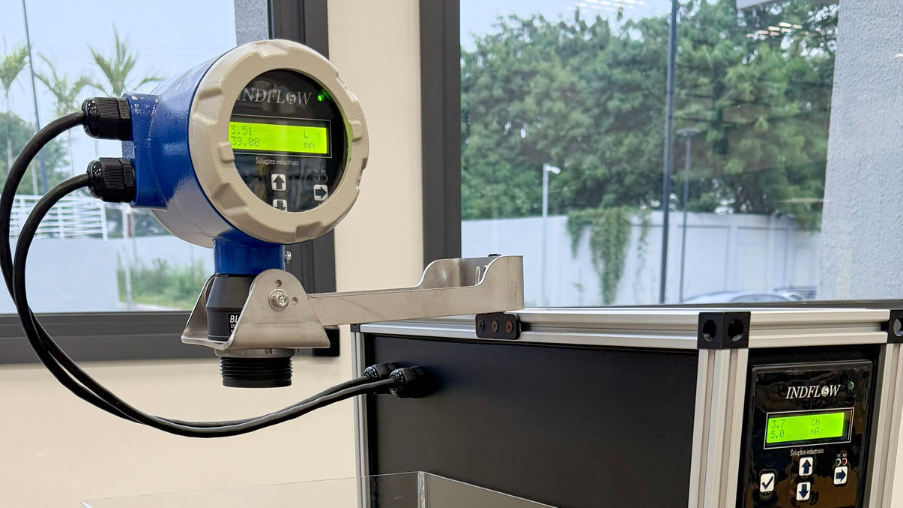
The smart storm drain sensor automatically monitors the water level and the accumulation of debris inside the structures. When it detects that the basket is nearing maximum capacity, the device sends an alert to the maintenance center.
With this real-time information, city crews are able to clean the drains at the right time, before they become clogged. The technology helps prevent flooding, increases operational safety, and optimizes the use of crews and public resources.

The smart scent diffusion system uses exclusive fragrances to make spaces more pleasant, welcoming, and memorable. In this space, the experience is created by the Nevoar BT500 diffuser, which is controlled via smartphone and designed to distribute the scent evenly.
The fragrance is called “Scent of Innovation” and was created specifically for the Innovation Center. In addition to promoting well-being, the solution reinforces the space’s identity through a unique and memorable sensory experience.

The system integrates various types of urban infrastructure, such as smart storm drains, cameras, river gauges, streetlight switches, and connectivity devices. All of these work together to monitor, in real time, conditions related to traffic, street lighting, water levels, and flood risk.
The data is sent to City Hall’s control center, enabling remote control of services and faster responses to incidents. The technology helps prevent flooding, improve safety, reduce operational travel, save energy, and lower greenhouse gas emissions.
Smart traffic lights use technology to adapt to traffic conditions and make it safer for pedestrians to cross the street. Some systems automatically adjust signal timings based on vehicle flow, while others offer countdowns, audible signals, and supplemental lighting to guide pedestrians—including those with limited mobility—enabling faster responses to road conditions.
This solution helps reduce traffic congestion, improve traffic flow, and increase safety for drivers and pedestrians.
Barão de Mauá Square is part of the David Cohen Center for Innovation, Technology, and Entrepreneurship, serving as a showcase for technologies applied to public services in Santo André and bringing the public closer to solutions for a more efficient, sustainable, and connected city.
The space features smart storm drains, river flow meters, cameras, connected street lighting, and the Smart Traffic Light System, complete with sensors, remote control, and accessibility features. These solutions send real-time data to City Hall, helping to prevent flooding, improve mobility, and enhance safety.
The Call for Proposals aims to select public and private legal entities interested in entering into a Cooperation Agreement, with the purpose of supporting the operations and functioning of CITE —the David Cohen Center for Innovation, Technology, and Entrepreneurship—and the Santo André Technology Park, including the implementation of fully or partially shared infrastructure, with specialized equipment and facilities such as a Demonstration Facility and/or Technology Platform.
Submit your proposal for a technology demonstrator to become part of the Santo André Technology Park Innovation Center’s initiatives. The team will evaluate your proposal and contact you to guide you through the next steps.
